Showing posts with label class. Show all posts

Friday, July 2, 2010

Villainous or Misunderstood?

Article and Photo by: Kaitlyn Shanks and Madison Howard, M&M TIPsters

“This class is really interesting; it lets you get into the villain’s perspective of things.” stated Elizabeth Roten, a rising freshman from Spring Hill, Tennessee. Elizabeth is taking the villains class here at UGA. The villains’ class learns about famous villains from stories and depicts their characteristics.
“ The reading and a lot of the videos we have watched in class. Discussion, I like analyzation,” said Dillon McDermott, a rising sophomore from Port Charlotte, Florida.
While we visited the class we witnessed a few of them giving their end of term projects, they were amazingly in depth and thorough. Many chose to defend the villains of popular tales and stories as they thought they had more sides to them than the original text might have explained. Maddy Longacre, a rising junior at H.B. Plant High School in Tampa, Florida, sketched and wrote out a screen play for a scene from Othello. Her project was incredibly detailed to the point where she would describe the camera angles and the shadows she would cast over the characters. Dillon, however, did something much more silly by writing a parody song of "Good Riddance" about this character that he related to.
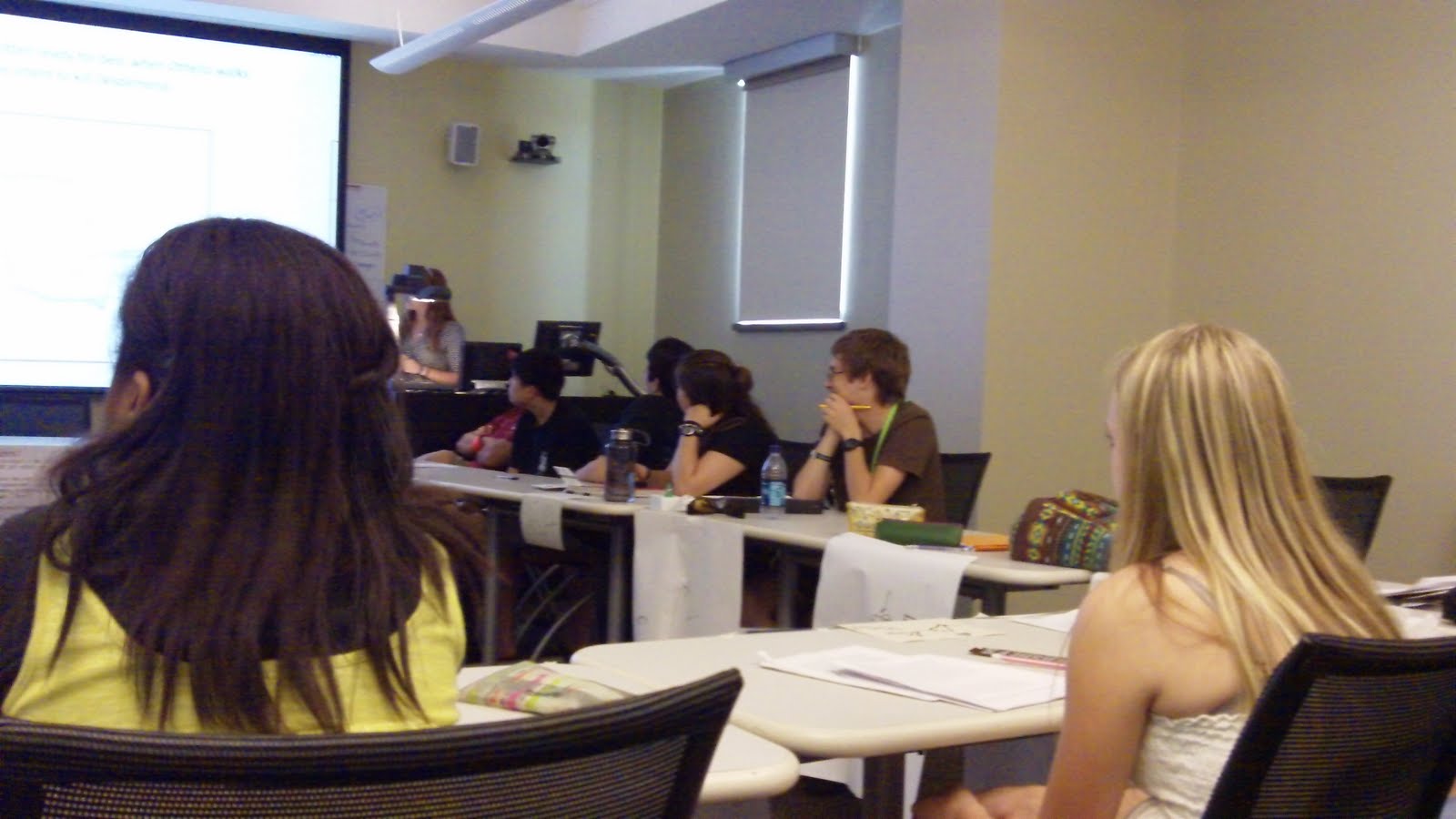
Joe Lease from Athens, Georgia, the instructor for the Villains class, loves teaching tipsters. “I would say their enthusiasm, its much different from a typical school environment. They really get into the work and throw themselves into it.”
Overall, many students enjoyed the class and how they got into the different layers of stories and characters. Hopefully, next year, more TIPsters will enjoy this class as much as this years Tipsters did.

Thursday, July 1, 2010

Spreading the Message

Article and Photos by: Ben Calvo, M&M TIPster

“This class has a good variety of media outlets that we get to learn about...I appreciate what I’ve learned and hope I can use it in the future.” Was what 14-year-old Brittney Vidal from Fort Worth, TX had to say about her class at Duke TIP this year. At the UGA campus, TIP offers a class called Media and the Message where students learn how to communicate and deliver news in the digital age.
When 14-year-old Adam Moore from New Port Richey, Florida was asked to describe the class, he said, “It basically got me out of the cave I was in and introduced me to different things.” Adam talked about being introduced to sites that are useful in terms of getting information out. Students learn valuable skills that can be applied to different paths of life. 14-year-old Madison Howard from Clinton, NC said, “My favorite part is the filming because I want a career in the film business.” Students took the first week of class to learn about the growth and popularity of blogs. The second week was nicknamed journalism boot camp where students wrote articles on topics that could interest local teenagers. Topics written about ranged from downtown and local camps offered to teens. Lastly, in the third week, the students wrote articles pertaining to TIP and all the wonderful experience of the campers.
For many students, their classmates were the best part of the class. “I love the people,” said 14-year-old Marissa Karp from Savannah, Georgia. “They’re all so cool.” Most of the other students agree the atmosphere of the class is a good one. The students joke around at break time and have formed a class bond and make each other feel at home. “I love the friendships I’ve made here,” said 15-year-old Abby Hunt from Tupelo, Mississippi.
This class offers students with the opportunity to view the world of the media through a different perspective. Students learn the value of giving news to the public, how to be a good journalist, and made amazing friends in the process. SUCCESS!

If it Pleases the Court

Article By: Ben Calvo and Madeline Goss, M&M TIPsters

“Stand strait, be a presence. This is your argument and you are right.” This is Dylan Nix’s advice to an attentive student after a mock trial. Once you enter the silent court room, the atmosphere changes drastically. As silent observers, we the reporters were quite intimidated. One can only imagine the fear coursing through the students who had to present a case in front of their instructor and TA.
However, all the students agreed that mock trial was the most enjoyable part of the class. “I really like the mock trial part more than reading cases” said 14-year-old Anna Logan from Columbus, Georgia. During a mock trial, two students present their side of the case to their instructor and TA. One student is the prosecutor and the other is the defense. After both have stated their argument to the jury, they receive an evaluation from the instructor. Every student spent two weeks preparing for this case and they had two days to write their two,10 minute speeches. Students then have a day and a half to prepare their entire argument. Their arguments are expected to be 5-6 pages and are to be memorized. “I really like mock trial because it’s more hands on.” Said 15 year old Kanise Thomson from Atlanta, Georgia. Students in the class learn how to carry themselves in a court and how to present their argument in an effective manner. This helps students to improve their communication skills and express their opinions in a professional way. Some students have found that this class is excellent practice for their future careers. “I really want to go into law and that’s why I chose this class.” Said 16 year old Erin Radziwon from Coconut Creek, Florida.
When students aren’t preparing for the trial, the class reads over cases and has intense class discussions. Students study the Supreme Court and how they interpret issues and debate over them. The class also learns about moral controversies within the practice of law, such as the death penalty and the insanity plea.
Criminal Law is a great opportunity for those interested in our justice system or for a student passionate for debate and the art of persuasion. With an intense study and a rigorous schedule, this class will have students prepared for any argument coming their way.

*Here are the links to videos from the competition:
Erin Radziwon
Justin Elliot
Gabriel Fu

Robotics

Article and Photos by: Maddie Kim and Courtney Scoufis, M&M TIPsters

While for most students robots are something of the future, this class sees robots are a normality. These students actually build their own robots! Programming, designing, and testing are all a part of the process. Out of all of the classes, this is potentially one of the most hands-on. “The hands-on technique of learning, and it’s not really all about taking notes,” says Julie Hubschman when asked about her favorite thing about the class.
David Swanson(instructor)and Derry Roberson(TA)lead the class in exciting activities. Both are knowledgeable people with Robotics backgrounds. For the past few days they have helped the students research technology related to Robotics. These topics include electric cars, robots for the army, a robot that mows your lawn, EMILY- a motorized lifesaving device, and a new addition to the Xbox family. These projects are interesting to listen to because they seem like things of the future, but in actuality, some already exist and some are coming out as soon as the end of this year. Students talked about improvements that could be made to the products, costs, release dates, and functions of the products.
This class isn’t all work though. The students took a fieldtrip to Georgia Tech in Atlanta to study the robotics program. “It was very interesting and fun, seeing the humanoids,” says Julie Hubschman, Robotics TIPster and Fourth Year.They saw some of the robots that they are working on like the Robo-lawnmower. Devon Myers said, “I had so much fun on the fieldtrip, it was really neat.”
The students learned a lot throughout this course. “I’ve learned things I never thought a robot could do,” says Julie Hubschman, a Robotics student. Not only have students learned, but they’ve also had fun. “Most of the time you’re just messing around with a robot, trying to make it better,” says Luke Portera, a Robotics student. A lot of students would say that Robotics is the future.
No one knows where the Robotics students will be in several years.“I want to do something with technology and robotics,” says Max Kennard, Robotics student. Thanks to the instructor and TA, these Robotics students will go far. “It’s very lucky that I’ve been here because, you know, I get to play with toys all day,” jokes Kai Charles, a Robotics student.

Introduction to Veterinary Medicine

By: Kaitlyn Shanks and Brittney Vidal, M&M TIPsters

As we entered the small hallway of the veterinary medicine lab, we were anxious to see the dissection of the pig eye. Early in the classroom we sat invisible to the students, while they went over the procedure and the different parts of the eye. The class was excited but not nervous; they have done many dissections before.
Thirty-two white and blue latex gloves were snapped on as the students surrounded a black top lab table and the dissection kits were handed out. Sixteen students divided up into teams of two or three as they prepared to start this somewhat daunting task. We started setting up our equipment as they got out the silver trays and lined them with paper towels. Next, they received their tools: scalpels, scissors, and a pointer.
“The dissections.” Hunter Selton, a rising 9th grader at Episcopal High School in Fernandina Beach, Florida answered immediately when asked what his favorite part of the class was. Many students agree with him as they can learn a lot from hands on activities.
“My favorite part of this class is all the hands on experience that we’re getting…” Arianna Evans, a rising 11th grader at Marjory Stoneman Douglas High School in Parkland, Florida explains. She loves the science classes offered at Duke TIP, and even though she is not interested in becoming a vet, she enjoys the class.
“I would say, probably, hearing from the experts, umm, I know a lot about stuff in general but we have got some really good experts here at UGA that have come in and talked to the kids about their specialties”. This is what Cassandra Peterson had to say when asked what she thought was her student’s favorite part of the class. Ms. Peterson is in veterinary school, she will complete her degree in two years. Ms. Peterson is from St. Joseph Illinois. She loves teaching the TIPsters. “I love working with these kids, they are all excited!”
Though this class has its golden moments, it also has its time in the trenches. When asked what his least favorite part about the class was Hunter Selton said,” The hardest part, umm, is maybe the, uhh, research projects.” Many students responded to this question similarly.
The students all said “Yes” when asked if they were happy with their overall class. Congratulations to Ms. Peterson and her TA, Mark, for running a successful class.

Pharmacology Class

Article by: Amber Palmer, M&M TIPster

“Okay, you need to press it to your finger firmly, and then just click it. It might hurt, but that’s okay.” This is what we hear as we walk into the Pharmacology class of Duke TIP. “That didn’t hurt. I was expecting, ‘hey, there’s a needle stabbing into my skin, it hurts,’ but no.” After a few moments of intense concentration, there is a triumphant call of, “115!” The students are doing a hands-on experiment during their evening study session after learning about Diabetes and its effects on the body. They are taking their own blood glucose levels to see into a little bit of the daily lives of diabetics. “It’s an important skill to have,” their TA Jen says of testing the blood sugar. “You may have the disease some day, or you might have to help somebody who has it, and then you’ll have some experience with it. It’s good to know if a drug is working, and you won’t know unless you test it.”

Only half the class was there, since the other half was working on independent projects for part of the hour. There are fourteen students total in the Pharmacology class, and they all seem to love it. “It’s a great class!” exclaims AnnaMarie Koehler-Shepley, one of the students. “We do a lot of hands-on things, and [the class] gives us a lot of real life application.” The only real downside is having three different classrooms to learn in, and switch class throughout the day.

The average day for Pharmacology students starts with a “lecture” on the background information concerning what they will be learning throughout the day. Then, they have a short break and it’s back to learning, this time from a video. After lunch, they will usually have a lab coinciding with the things they learned earlier in the day. They finish up with reading articles until the end of class. When they aren’t stabbing themselves with needles, evening study can include anything from playing games to reading. “We study a lot about the systems that drugs interact with, and recently we’ve been learning about the physiological effects on the body,” says AnnaMarie.

Katie Seaman, one of the fourteen students, says her favorite part about the class is, “doing experiments. Definitely.” These experiments sometimes include dissecting pregnant rats and their babies. During this lab, the students were learning about the organs involved in metabolizing, and one of the rats had babies which were cut open as well.

Pharmacology students learn about nearly everything medical; any drug, any medicine, any disease. This includes one student’s favorite subject to learn about: abuse drugs. These are the addictive drugs that countless people get involved with. AnnaMarie explains, “It’s a widespread issue, and it affects so many people. They get hooked from just trying it, and it’s cool to know how it works so we won’t [get hooked].” Pharmacology is a great class, and all the students love it.

Ouch! My ACL!

Article and Photos by: Madison Howard, M&M Tipster

This year, Duke Tip offered a Sports Medicine Class. Sixteen lucky students get to learn about sports injuries every day. Here is what happened on June 30, 2010.
Dr. Kristina Black, a clinic and emergency room physical therapist, came to speak to the class. She attended Dunwoody High School and attended college here at UGA. She then moved to Colorado and became a doctor. Originally, sports medicine and orthopedics were not here first choice for a job.
After going through training she decided that it actually was something she wanted to do as a job every day. She talked about injuries that she had witnessed over her years of being a doctor. She works in a hospital and clinic on the bottom of a ski slope in Colorado.
When asked what the most common injury is for skiers she replied, “A torn ACL, definitely. The ligament is really easily torn.” An ACL is a ligament in your knee that is very painful to tear and can cause much damage. In a normal case, there would be six months of physical therapy for a torn ACL. Snowboarders are a very different story. Snowboarders usually tear something in or dislocate their shoulders.
Nine fatalities occurred at the hospital she works at in the last year. Dr. Black works a ten hour day, four times a week. She sees a new patient about every forty minutes. Kristina usually sees around fourteen patients a day in the clinic, but the ER is erratic and the number of patients change every day. In the ER, a patient will always see a physician before seeing her, because she is a physical therapist. That happens mostly because of the MRI. MRIs cost from $1500 to $2000. The physician determines if the patient needs one or not and Dr. Black checks to make sure that the physician’s judgment is correct.
Dr. Black works frequently with post-op patients. She enjoys this because of the attitude challenges she often faces. When people lose their mobility they are often bitter and don’t want to undergo physical therapy. But, Kristina encourages them to continue to try so they may gain some of their mobility back.
Dr. Black is lucky to work with some outstanding physicians. A close worker performed surgery on A-Rod, a famous New York Yankees baseball player. A-Rod had hip surgery to prevent arthritis and to repair some of the ligaments in his hip. Kristina helped Lindsey Vonn, a famous skier, with her agility training. Since Lindsey goes up to seventy to ninety miles per hour, she has to have help from a doctor to prevent injury.
Another patient that she discussed was a twenty- two year old male that was a paraplegic. He broke his neck while diving into a lake. Your neck is divided into sections; he broke the parts of his neck called C3 and C4. C4 is near strands that connect the brain to the body, that is why the man became a paraplegic. He could only move his head and was on a ventilator for a few months. Gradually he began to gain some movement back into his body. By the end of her time working with him, he could move his arm forward and backward. This made driving an electronic chair easier, because when he first got the chair, he controlled it by a special straw that he blew into.
Dr. Kristina Black believes that possibly, in twenty years, science will have evolved more, and being paraplegic could be cured or could be much less severe due to new treatments and medicines.
To be a physical therapist, you must be strong. Lifting patients that don’t have any mobility is not easy; having stregnth makes it easier and faster.
The sports medicine class had finished a debate about football the day before Dr. Black was to speak. When asked if she thought football should be banned, she replied, “No, I don’t think football should be banned. I don’t know what I would do on Saturday nights if UGA didn’t have a football team. But, I do think football should have more penalties. Football is certainly a dangerous sport.”
Dr. Black then said her goodbyes. After this riveting discussion with Dr. Black I interviewed Madeline Taylor, a 14 year old rising freshman from San Antonio, Texas. This is her second year with the Duke Tip program; she attended ASU last year. When asked what her favorite part of the sports medicine class was, she replied, “I like the anatomy part.” This class was originally Madeline’s second choice, but she believes she likes this class better than she would her first choice. Madeline’s first choice was veterinary medicine. She likes her teacher and TA and thinks that, “The things we learn are cool. I find medicine very interesting.”

Wednesday, June 30, 2010

Wonders Of the Brain

Article and Picture by Ben Calvo and Madeline Goss,M&M TIPsters

“I would not change anything about my class. It’s just that fun.” Victoria “Tori” Watson, a 15 year old TIPster from St. Luis, Missouri says when asked to describe her class
This year at UGA, the TIP program offered a class called “The Brain, Intelligence and Creativity”. The class is an intense study on the human brain and its function and the diseases that can occur within it. While many TIP students would be scared at the intensity and the workload of the class, students participating in it assure that the class is well worth it.
“The teacher is really good and I like what I’m learning” said Natalie Waino, a 15 year old TIPster from Florida
We observed, during our trip to the class, that the students seem extremely comfortable with their teacher Desi. Tori Watson, Natalie Waino and Adrienne Cassel all agreed that their favorite part of the class is their instructor. Tori Watson said, “She finds ways to bring in people to talk about it so it’s not always the same thing every day.” Students are also fond of their TA Ryan. “He always finds fun activities for evening study,” said Tori.
While most would jump to the conclusion that the class is a hard core science class, Tori says that “the class is open for interpretation.” In addition to learning about how the brain works, students learn and observe how people think and view the world. Debates and discussions are a regular part of the class, and these range from ethical issues and arguments on why things are the way they are. Students also read articles pertaining to new sciences and discoveries surrounding the brain, have group discussions, and as a treat, they regularly watch Freaks and Geeks, a comedy show that the whole class enjoys.
Students also love the activities that come with the class. Natalie Waino and Adrienne Cassel agree that their favorite activity that they have done is the dissection of the sheep brain. Another activity that the class has done is a hallucination exercise where the subject will tape two ping-pong halves over their eyes, and stare into them. The brain, presented with a white plane, will try to place something in front of it, creating a hallucination.
The Brain class provides TIP students with an amazing opportunity to study one of the most complex organs in our body, but allows them to do it in a non conventional way and encourages them to have fun with it. Future TIP students should most definitely consider this class.

Fo Po, Fo Sho

Article by Courtney Scoufis and Landon Willey, M&M TIPsters

We walked into the American Foreign Policy Tuesday morning to see two groups of TIPsters on opposite sides of the classroom; both avidly debating. The topic? To make a North American Union out of the United States, Canada, and Mexico. This Union would be similar to the European Union. The students were divided into two groups. Each group had three delegates from each country. In each group, there was conflict between delegates from other countries and between delegates from the same country. In order for something to get passed, two of the three countries had to agree to it in the group. The two groups were given three possible results to shoot for in the negotiations and were told to “try for the one which would benefit them the best.” The options given to them were: Mutual Cooperation, Supernational Government, or a North American State. As expected, each option had its own drawbacks and highlighte. A Mutual Cooperation would not be very formal or strict, which in itself sounds a little…sketchy. A Supernational Government would require America, Mexico, and Canada to recognize each other under the same government, but they still would remain separate countries. A North American State would be a virtual super country, resulting in a single country occupying the entire North American Continent.
Group one decided to name their alliance the North American Tri-National Alliance (NATA for short.) A delegate of Canada, Elena Woods, a rising freshman, said that her country wanted a this agreement so they could discuss pressing topics such as, “the economy, and matters of states such as the wars in Iraq and Afghanistan.” She said they are trying to stabilize their economy and get a larger position on the world stage. United States delegate Sam Gray, a rising tenth grader said that, “the United States wants to have Canada and Mexico as allies. Also so they would have some influence on what goes on in the other countries. Gray said that the countries could also help each other out economically and that Canada and the USA could help fight the Drug Cartel in Mexico.” Morgan Baskin, a delegate from Mexico, agreed with Gray in the fact that Mexico wanted Canada and the USA as allies.
The ending result for NATA was well thought out and was agreed to by all the countries. Woods admitted, “[Our] plans were basically the same.” The debate for group one resulted in having the central banking system in Montreal. The meeting locations would change between Washington DC, Mexico City, and Ottawa. The capitol would be in Chicago due to its location and the fact the Mexico has stability issues says that it couldn’t handle it. The government time would be a semi-presidency or as tenth grader Keaton McManamy put it, “democracy parliamentary congress.” All of the countries agreed to converting the Peso and Canadian Dollar to the United States Dollar over the time span of five years. This is to “make sure the Peso[and Canadian Dollar] are prepared to move on to the dollar,” said McManamy.
Group number two was the source of many interesting quotes. Canada and America had negotiated each other to an agreement supporting a Supernational Government, and Mexico was heatedly contesting the vote, supporting a North American State. In the midst of the debate, I managed to ask Josh Stallings, a Canadian representative, what he thought of the option the Mexican’s proposition, to which he replied, “It’s not gonna happen.”
In the end, Group number two decided upon a Supernational Government. And, through extensive diplomacy and negotiation, the Canadians and Americans managed to get the Mexicans on board. Daniel Sweat of the Mexicans stated, “Through graceful influencing from Canada, we’ve decided on option number two” which was the Supernational Government. Mexico stated that they agreed to the change, “In order for equal prosperity and development of all nations of North America [and] in order to insure a better future.”